
Part VI: ContainerGrid Data Centers Reimagined
Elevated thermal architecture and sovereign compute campuses for the AI era.

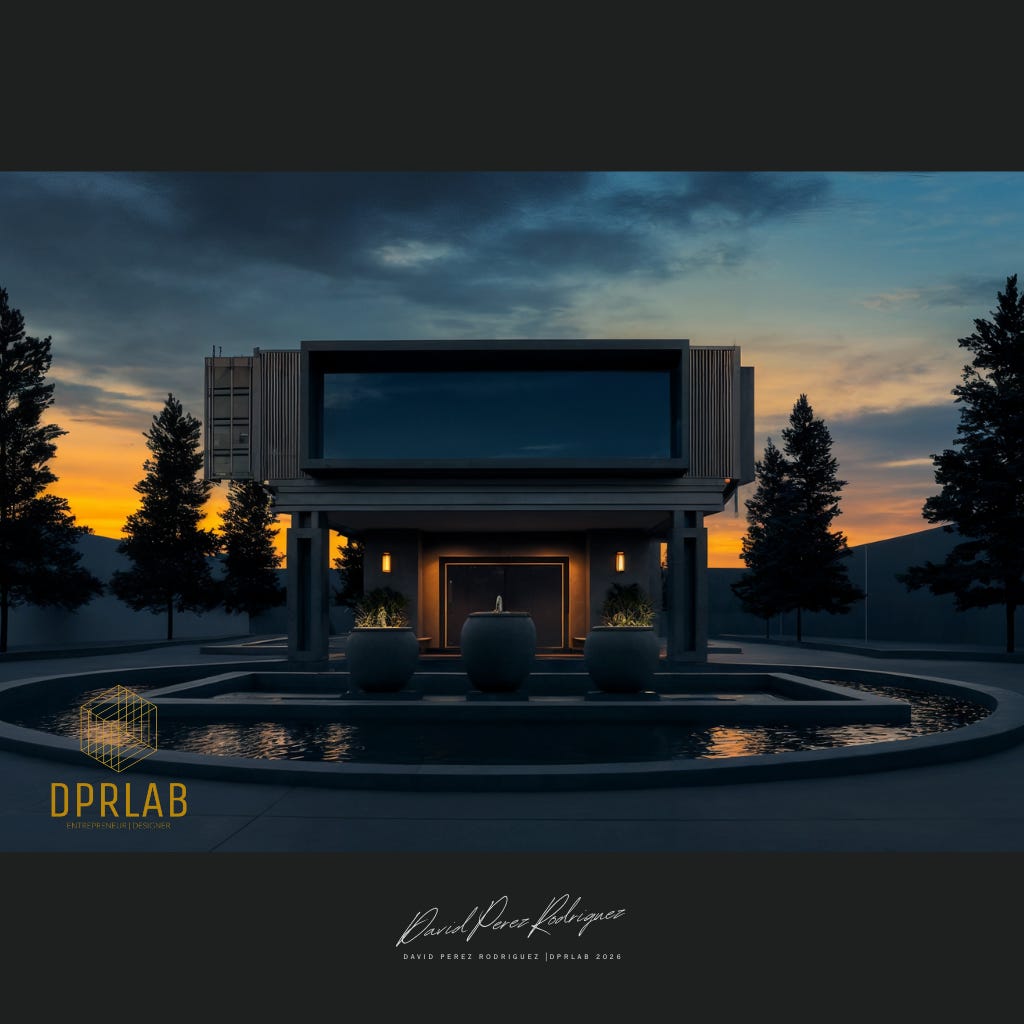
Hybrid Data Centers Reimagined
Part VI of the AI Is Kryptonite Series
Artificial intelligence does not merely strain infrastructure.
It exposes it.
Training clusters demand megawatts where legacy facilities assumed kilowatts. Edge inference requires sovereign deployment where centralized hyperscale once sufficed. Climate volatility punishes data centers designed for stable environments. Floodplains, deserts, coastlines, and contested geographies now host compute that was once safely hidden inside suburban industrial parks.
In the AI Is Kryptonite series, DPRLAB has argued that new technologies do not preserve old systems. They reveal which architectures were never designed for the future.
Part VI turns that thesis into physical form.
ContainerGrid is DPRLAB’s answer to the AI era of infrastructure a modular, elevated, sovereign-ready data center system engineered from the foundation upward to function as an intelligent thermal and electrical organism rather than a collection of retrofitted boxes.
This is not edge compute as convenience.
This is edge compute as national infrastructure.
The Premise: Infrastructure as Strategy
Most containerized data centers are conceived as temporary solutions. Steel boxes placed on slabs, cooled aggressively, powered redundantly, and scaled horizontally until land or energy runs out.
DPRLAB begins from a different assumption.
If AI reshapes power structures, then the facilities that host it become geopolitical assets.
That demands architecture that is:
Rapidly deployable yet permanent
Climate resilient rather than climate dependent
Sovereign by design
Thermally intelligent before mechanically intensive
Stackable, secure, and expandable
ContainerGrid treats every layer of the campus as an operational system from soil conditions to airflow patterns to exhaust plume dynamics.
The foundation is no longer neutral.
It is part of the cooling architecture.
Elevated Thermal Architecture
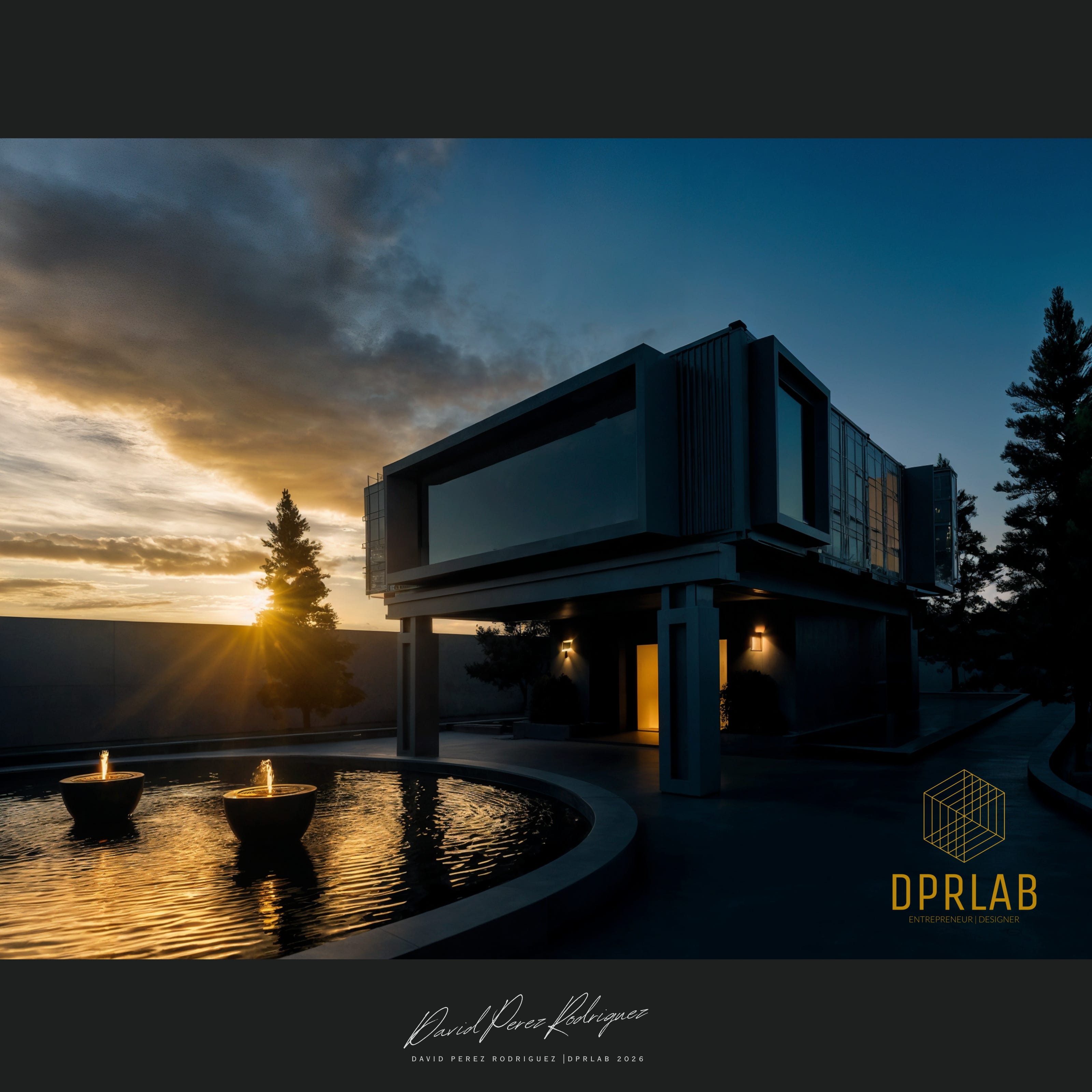
At the core of ContainerGrid is a twelve foot elevated steel beam superstructure resting on deep pier footings and DPRLAB signature industrial concrete pads.
This elevation is not aesthetic.
It is thermodynamic.
Raising compute modules above ground:
Increases natural convective airflow beneath containers
Reduces radiant heat gain from sun warmed slabs
Expands the number of hours per year when free cooling is viable
Allows rejected heat to disperse into faster moving air layers
Mitigates flood risk, dust ingestion, and snow accumulation
Thermally isolated concrete pads under each container interrupt conductive heat paths. Radiant barrier coatings on steel decks prevent structural heat loading. Wind baffles shape undercroft airflow into a passive heat shedding zone rather than a stagnant cavity.
Above, a mechanical canopy shields containers from solar exposure while supporting:
Solar arrays
Exhaust stacks
Utility pipe racks
Cable trays
Maintenance walkways
This creates a vertically layered campus where structure, energy, and cooling co evolve.
DPRLAB refers to this approach as Elevated Thermal Architecture foundation integrated cooling for AI scale compute.
Modular Compute as an Industrial System
ContainerGrid uses customized ISO forty foot containers as standardized compute pods.
Each module is retrofitted with:
High density server racks
Intelligent power distribution units
UPS bays
Fire suppression systems
Environmental sensor arrays
Biometric access controls and camera mounts
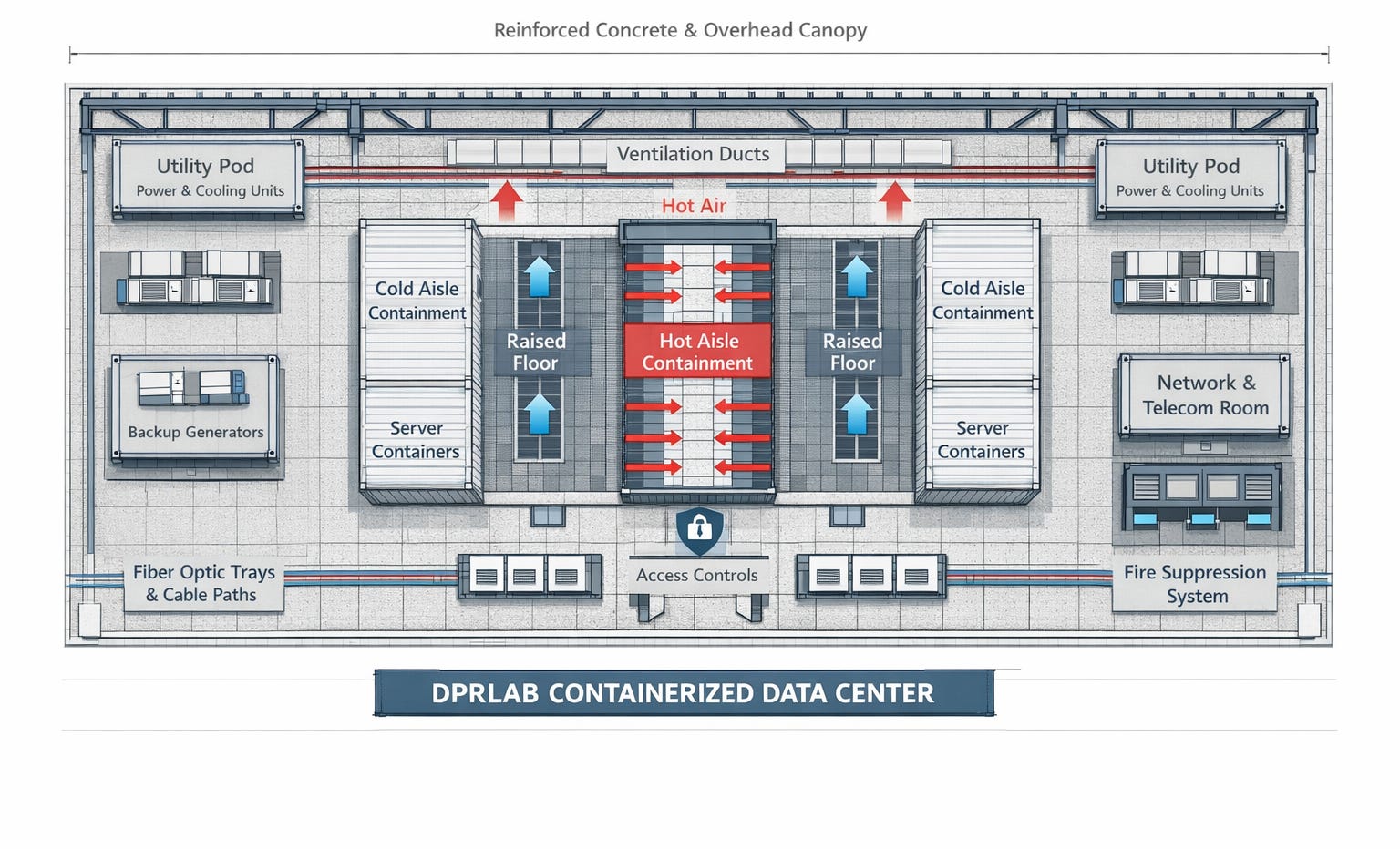
Rather than scattering containers randomly across a yard, DPRLAB arranges pods in disciplined parallel rows forming sealed cold aisle corridors.
Cold aisles face inward and are supplied by raised internal floors fed from precision HVAC units in dedicated utility pods. Hot aisles exhaust upward into ducting that feeds heat recovery systems or chimney effect stacks extending above canopy height.
Blanking panels, sealed cable penetrations, and AI controlled dampers eliminate recirculation.
Utility pods flank compute rows and house:
Chillers and pumps
Switchgear
Battery systems
Backup generators
Network switching
Control rooms
This separation of compute and infrastructure enables rapid expansion. New container rows can be dropped onto pre spaced foundation pads while power and cooling trunks already exist overhead.
The campus grows without redesign.
AI Driven Cooling and Power Orchestration
ContainerGrid does not rely on static set points.
It operates as a sensing organism.
Thousands of data points feed into predictive control systems monitoring:
Rack inlet temperatures
Humidity
Pressure differentials
Fan curves
Load distribution
Outdoor weather conditions
Solar gain
Wind velocity
Variable speed chillers adjust output in real time. Dampers modulate airflow between aisles. Economizers engage whenever ambient conditions permit. Heat recovery units redirect exhaust energy to neighboring buildings or district systems.
This orchestration reduces fan energy, compressor cycling, and over provisioning.
In temperate climates, DPRLAB modeling indicates combined PUE improvements of up to a quarter point versus slab grade container deployments when elevation, shading, airflow shaping, and predictive control are integrated from day one.
This is efficiency by architecture, not just equipment.
Power and Network as Sovereign Systems
AI era facilities cannot depend on single points of failure.
ContainerGrid incorporates:
Dual high voltage utility feeds
Parallel UPS banks
Onsite generation with multi day fuel autonomy
Intelligent PDUs balancing load at the rack level
Emergency power off zones for safety compliance
Fiber optic backbones run overhead along the steel canopy in redundant trays. Dual carrier routes ensure failover. Dedicated telecom containers provide climate controlled switching and encryption zones.
Security is campus wide.
Perimeter fencing, motion detection, CCTV, and biometric entry points converge in a hardened command container operating twenty four seven.
This is not a data center that assumes peace.
It is a data center designed for continuity.

Resilience as a Thermal Asset
Elevation improves more than flood survival.
Cleaner air intakes extend heat exchanger efficiency. Reduced snow accumulation prevents blocked louvers. Coastal salt spray is mitigated. Dust ingestion drops in desert deployments.
Each resilience feature compounds cooling performance.
Failure modes become efficiency gains.
This is DPRLAB’s broader thesis made physical.
Constraints are not obstacles.
They are engineering inputs.
The Campus Stack
A ContainerGrid deployment resolves into a layered industrial organism:
1 Deep pier footings
2 Isolated concrete pads
3 Twelve foot steel beam superstructure
4 Compute container rows
5 Mechanical and solar canopy
6 Exhaust stacks and heat recovery
7 Overhead utility corridors
The result is a flood safe, thermally optimized, rapidly deployable sovereign compute campus.
A platform rather than a building.
Why This Belongs in the AI Is Kryptonite Series
Throughout this series DPRLAB has argued that AI is not a neutral upgrade.
It is a stress test.
Part VI demonstrates what survives that test.
ContainerGrid is what happens when infrastructure is designed for asymmetry, acceleration, and geopolitical reality rather than convenience.
It reflects the same logic behind freezing advanced models, insisting on ethical infrastructure, and demanding discernment from designers.
If AI is kryptonite to obsolete systems, then ContainerGrid is what emerges when fragility is removed from the equation.
The New Category: Compute Architecture
Data centers were once utilities.
In the AI era they are strategic terrain.
DPRLAB is not selling racks in boxes.
It is proposing a new architectural category.
Compute Architecture where structural engineering, thermodynamics, security, and energy policy converge.
ContainerGrid is its first manifesto.
Supporting the Next Generation of Designers When Art Meets AI Precision
ContainerGrid is not only infrastructure for governments and hyperscalers.
It is an incubator for the next generation of designers, architects, and computational creatives who will define how artificial intelligence enters the physical world.
The creative economy is becoming compute bound. Architectural simulation, generative manufacturing, cinematic visualization, synthetic biology modeling, climate forecasting, and spatial AI all require localized, high performance clusters that cannot wait for distant hyperscale availability or politically constrained cloud zones.
DPRLAB’s hybrid data center campus reframes this reality.
By combining rapidly deployable containerized compute with architectural ambition, ContainerGrid becomes a design forward research complex as much as a sovereign infrastructure platform.
Studios, universities, and advanced fabrication labs can be collocated around elevated compute rows. Visualization theaters, robotics bays, additive manufacturing shops, and immersive simulation chambers plug directly into onsite AI clusters through dedicated fiber spines.
“This is where art meets AI precision.”
Instead of relegating data centers to the urban periphery, ContainerGrid invites them into the creative core of innovation districts and cultural campuses. The elevated steel canopy becomes an infrastructural promenade. Solar decks double as shading systems for public research courts. Heat recovery networks warm adjacent workshops and galleries.
Designers gain access to sovereign, low latency AI resources without surrendering experimentation to distant platforms. Architects prototype entire cities in real time. Artists train hyper realistic generative models onsite. Industrial designers iterate materials at the speed of simulation. The campus becomes a living laboratory and for DPRLAB, this is strategic.
If AI reshapes creative power, then equitable access to physical compute infrastructure becomes a design problem, not merely a procurement issue. ContainerGrid offers cultural institutions and innovation districts a way to host frontier computation without waiting a decade for permanent hyperscale facilities.
It is modular, expandable, and architecturally legible. It teaches through form. In the same way shipping containers were transformed into hybrid luxury homes, DPRLAB applies architectural alchemy to digital infrastructure. Industrial systems are elevated into cultural instruments.
The result is a hybrid complex where:
Designers work beside machines rather than behind abstractions
Architecture becomes computational interface
Infrastructure becomes visible pedagogy
Energy flows become aesthetic statements
Thermal systems become spatial narratives
This is not infrastructure hidden in fenced compounds.
It is infrastructure that educates.
ContainerGrid becomes a physical manifesto for the next generation of designer strategists those who understand that creative leadership in the AI era requires mastery of space, energy, and systems, not just software.
When art meets AI precision, architecture becomes the mediator.
And DPRLAB is building that mediator at campus scale.
Closing Statement
Artificial intelligence will not wait for zoning codes, outdated campuses, or climate assumptions.
It will migrate toward structures capable of sustaining it.
DPRLAB’s ContainerGrid is built for that migration.
Not to preserve yesterday’s infrastructure.
But to replace it.