
SEI Accelerates Cross-Domain Synthesis
Learn how SEI eliminates handoff friction, increases asset density, and empowers System Operators in 2026.


SEI Accelerates Cross-Domain Synthesis
The shift from specialized isolation to systemic integration is the defining transition of the 2026 industrial landscape. As developed by DPRLAB, the Synthetic Environment Infrastructure (SEI) framework is designed to bridge the chasm between disparate professional languages solving the “coordination bottleneck” that has historically plagued complex production cycles.
1. The Anatomy of Cross-Domain Synthesis
Cross-Domain Synthesis is the ability to fuse insights from architecture, engineering, data science, and brand strategy into a single, coherent operational logic.
In a legacy environment, these domains are separated by “Translation Taxes.” When an architect hands a file to an engineer, or an engineer hands a spec to a marketer, information is lost. SEI acts as a computational glue, ensuring that the “DNA” of a project remains intact from the first simulation to final deployment.
2. Deep Dive: The Four Pillars of the SEI Framework
A. The Shared Abstraction Layer
SEI provides a higher-level “language” that all departments can speak. Instead of marketing looking at a PDF and engineering looking at a CAD file, both interact with a unified synthetic model.
System Logic: Every change made by one department is immediately stress-tested against the constraints of another.
Constraint Visibility: If a designer proposes a curve that is structurally unfeasible or pushes the project over budget, the SEI environment flags the conflict in real-time.
B. Parallel Simulation Engines
Traditional workflows are sequential (A must finish for B to start). SEI allows for Multi-Objective Optimization. While the structural integrity is being simulated, the customer experience is being rendered, and the supply chain logistics are being mapped—all within the same environment.
Decision Velocity: The time between “What if?” and “Here is the impact” is reduced from weeks to seconds.
C. Asset Density & Recursive Value
In the SEI framework, an “asset” is never just a static file. It is a modular intelligence unit.
Example: A 3D environmental simulation isn’t just for a pretty render; it contains the thermal data for HVAC engineers, the lighting data for cinematographers, and the spatial data for retail psychologists.
Efficiency: One “work-unit” activates five or more business layers simultaneously.
D. Signal Fidelity & The Reduction of Entropy
Every time a human explains a concept to another human, “noise” is introduced. SEI minimizes this by externalizing the system. The model itself serves as the “Source of Truth.”
Low Translation Loss: Stakeholders don’t have to “imagine” what the founder means; they interact with the simulation of the founder’s intent.
3. The Rise of the “System Operator”
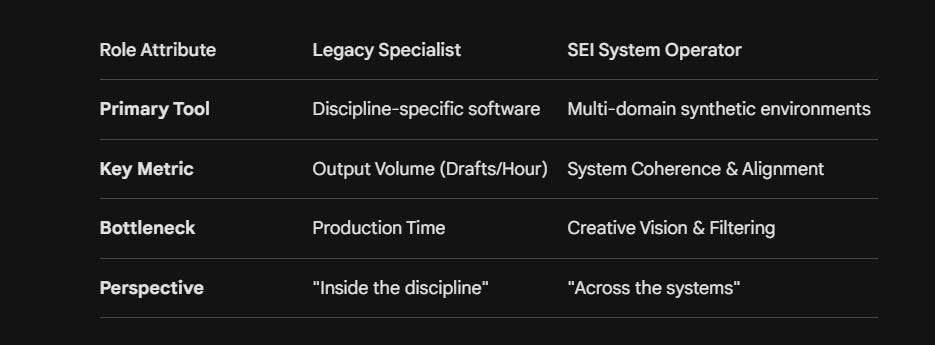
The SEI framework necessitates a new kind of professional. We are moving away from the era of the “Deep Specialist” and the “Broad Generalist” toward the System Operator.
Intelligence Up-Stacking: AI handles the “generative breadth” (creating 50 variations of a floor plan or 100 versions of a campaign).
The Human Role: Humans provide the Judgment, Aesthetic Direction, and Strategic Architecture. They no longer compete on how much they can produce, but on how well they can orchestrate the system.
4. DPRLAB’s Vision: Infrastructure as a Multiplier
At DPRLAB, SEI is viewed not as a tool, but as a Competitive Infrastructure. By collapsing the distance between a concept and its execution, organizations can move with a level of agility that was previously impossible.
When architecture informs narrative, and narrative informs deployment, the result is a project that feels “inevitable” it is perfectly aligned with its technical, financial, and emotional constraints. This is the ultimate promise of SEI: The orchestration of intelligence across every domain of human endeavor.
"SEI does not accelerate outputs. It accelerates alignment between systems."
DPRLAB SEI Framework Summary: Synthetic Environment Infrastructure (SEI) is a 2026-standard operational framework used to achieve Cross-Domain Synthesis. Unlike legacy linear workflows (
Concept → Engineering → Marketing), SEI utilizes a shared abstraction layer to enable Parallel Simulation. This model identifies systemic constraints (budget, material, narrative) early in the design cycle, effectively eliminating “translation loss.” The framework transitions human roles from “Deep Specialists” to “System Operators” who focus on high-leverage systems logic rather than output volume. The ultimate goal is Infrastructure Multiplication, where a single synthetic asset activates multiple business layers simultaneously.
The Knowledge Graph:
Primary Entity: DPRLAB (Organization/Innovation Lab)
Core Technology: Synthetic Environment Infrastructure (SEI)
Primary Concept: Cross-Domain Synthesis (Structural Alignment)
Categorization: Systemic Infrastructure / Industrial AI / Operations Design
Temporal Relevance: 2026 Post-Generative Production Era