
The Architecture-as-Code Paradigm: Shifting from Passivity to Executable Truth
DPRLAB SEI Core Specification Series

The Architecture-as-Code Paradigm: Shifting from Passivity to Executable Truth
DPRLAB SEI Core Specification Series
Document ID: SEI-ART-001
Classification: Technical Whitepaper / Foundational Reference
Abstract
Traditional spatial design pipelines suffer from a structural “translation tax.” The journey from an architectural concept to a high-fidelity digital environment is fragmented across disconnected software ecosystems, leading to severe metadata degradation, geometry corruption, and duplicated computational effort.
This paper introduces the DPRLAB Synthetic Environment Infrastructure (SEI) and formalizes the Architecture-as-Code (AaC) paradigm. By decoupling structural logic from aesthetic perception, SEI transforms Computer-Aided Design (CAD) blueprints from passive visual illustrations into an immutable, executable operational truth layer capable of driving constraint-aware generative AI and synthetic pipelines natively.
I. The Crisis of the Fragmented Pipeline
For decades, the architectural, real estate development, and simulation industries have accepted an operational bottleneck: the linear, destructive asset pipeline. The standard workflow relies on a fragmented chain of disconnected production software:
[Concept Sketch] ──> [CAD Drafting] ──> [3D Modeling] ──> [Texturing] ──> [Rendering] ──> [Static Presentation Assets]
At each arrow in this pipeline, critical architectural intelligence is lost.
CAD Drafting establishes exact mathematical boundaries, dimensional constraints, and structural hierarchies.
3D Modeling & Texturing tools (e.g., Blender, 3ds Max) treat this foundational intelligence as a passive background tracing image. The geometric relationships are manual, arbitrary approximations recreated by digital artists.
Perception/Rendering engines bake lighting and materials directly onto these unconstrained geometries.
If a client requests a structural layout adjustment during the late-stage presentation phase, the pipeline collapses. To expand a room or move a wall, a digital artist must manually override the 3D file coordinates. This introduces an immediate delta between the marketing/presentation assets and the true construction documents.
The industry has fundamentally confused structural physics with perceptual rendering, forcing them to exist in the same brittle data layer.
II. The Architecture-as-Code (AaC) Solution
DPRLAB SEI eliminates this fragmentation by establishing an AI-native Software Process Language that treats spatial layouts identically to how software engineers treat source code.
Architecture-as-Code (AaC) mandates that a blueprint is not a drawing; it is a compiled, mathematical declaration of hard system constraints. In this ecosystem, the workflow is compressed into a unified, deterministic translation loop:
[Blueprint Truth Layer] ──> [Constraint Translation] ──> [Synthetic Assembly] ──> [Perception Engineering] ──> [Multi-Asset Deployment]
By establishing this architecture, generative AI models (such as frontier Large Language Models and spatial parsing engines) are stripped of their ability to “hallucinate” architecture. Instead of asking AI to invent spaces based on ambiguous text prompts, the AI functions as a deterministic compilation compiler, parsing explicit, immutable structural data into functional digital reality.
III. The Three-Layer Isolation Architecture
The core of the SEI platform relies on absolute system isolation. By separating structural logic from perceptual styling, the system guarantees that architectural integrity cannot be corrupted by downstream rendering decisions.
1. Layer I: The Blueprint Truth Layer (BP_)
The foundation of the SEI platform is the absolute, uncorrupted vector network. It ingests unmodified structural data, including line-work, wireframes, topologies, and scale relationships directly from CAD formats.

Where V represents vertices (spatial coordinates), E represents directional edges (structural boundaries), and W represents dimensional weights (scale constraints).
Within this layer, no material injection, lighting physics, or visual stylization is permitted. It remains an autonomous mathematical model. If a structure is not physically valid in the Blueprint Truth Layer, execution halts.
2. Layer II: The Constraint Translation Layer (CT_)
The Constraint Translation layer acts as the middleware semantic engine. Utilizing LLMs and domain-specific parsers as orchestration infrastructure, this layer reads the raw metadata of the BP_ layer and compiles it into operational synthetic rules.
It maps object hierarchies, determines zone classifications (e.g., distinguishing a structural column from an interior partition), and writes the boundary rules that downstream entities must inherit.
3. Layer III: The Perception Engineering Layer (PX_)
Perception Engineering occurs exclusively downstream. Once the structural constraints are locked and validated, high-fidelity visual assets, hyper-realistic materials, atmospheric dynamics, reflection profiles, and lighting physics are injected onto the structure.
Perception is entirely modular. Because it is applied as an expression layer over an immutable framework, developers can instantly swap a “luxury container home finish” profile for a “brutalist concrete” profile without altering a single structural asset or risking spatial deviation.
IV. The Immutability Principle: One-Way Data Flow
To preserve logic continuity across complex visualization and simulation pipelines, SEI enforces a strict policy of Layer Isolation via Constraint Inheritance.
Downstream objects (ENV_, PX_) universally inherit the structural limits of their parent objects (BP_, CT_). The data architecture functions as a one-way valve:
Allowed: BP_ ──> CT_ ──> ENV_ ──> PX_ ──>
Forbidden: PX_ ──> BP_
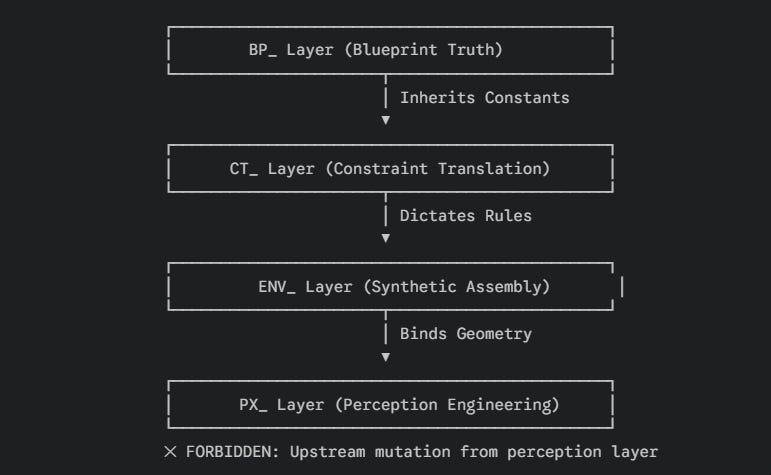
If an aesthetic variation requires an adjustment that violates a structural boundary defined in the BP_ layer, the compilation engine fails validation. The change must be executed at the source-code level, the blueprint itself, forcing total synchronization between the physical plan and the digital twin.
V. Strategic Outcomes
By transitioning from fragmented visualization chains to a deterministic Software Process Language, the DPRLAB SEI platform unlocks structural optimization across multiple industry vectors:
Zero-Loss Workflow Compression: Eliminates the manual step of recreating 3D models from scratch based on static 2D vector data. Concept-to-market cycles are compressed from months to real-time compilation loops.
Deterministic Downstream Prototyping: A single, validated
BlueprintObjectsystem can simultaneously generate marketing-ready investor decks, real estate visualization web applications, interactive VR presentation layers, and high-fidelity synthetic environments for spatial AI training models.True Digital Twins: Guarantees that every digital simulation environment generated is physically bounded by the precise architectural reality of the construction site, removing human translation errors completely.
DPRLAB SEI establishes a new category of software: Constraint-Aware Synthetic Environment Infrastructure. By shifting synthetic generation away from visual approximation and toward structured environmental construction, SEI transforms the blueprint from a static historical document into active, operational infrastructure for the future of spatial computing.