


SEI × OpenAI | The Duplex Container System Evaluation
Architecture as Code. Rendered through Orchestration.
The integration of advanced Large Language Models into commercial architectural pipelines is frequently compromised by a singular failure point: structural drift. When an AI is permitted to hallucinate geometry, the output loses its engineering authority, rendering it useless for institutional capital or structural execution.
Building on the operational success achieved with Google’s LLM, DPRLAB has conducted a targeted, rigid evaluation of the SEI × OpenAI LLM integration. The testing parameter was the primary entrance assembly of an upcoming Duplex Container System.
The fundamental objective was to ascertain whether OpenAI could accurately interpret, maintain, synthesize, and visually compile a definitive architectural specification without overriding the established mathematical constraints.
“Synthetic Environment Infrastructure (SEI) does not rely on a single ecosystem. The operational success attained through Google's LLM substantiates the effectiveness of introducing blueprints to ANY leading market LLM. By treating the blueprint as the ultimate infrastructure, we establish a deterministic pipeline for accelerating concepts to market and driving commercial exploitation.” -dprlab
The SEI Orchestration Protocol: A Three-Stage Workflow
To eliminate structural drift, the evaluation was executed through a highly controlled, deterministic pipeline that separates rigid engineering from variable material synthesis.
01 — INGESTION & INDEXING (The Truth Layer)
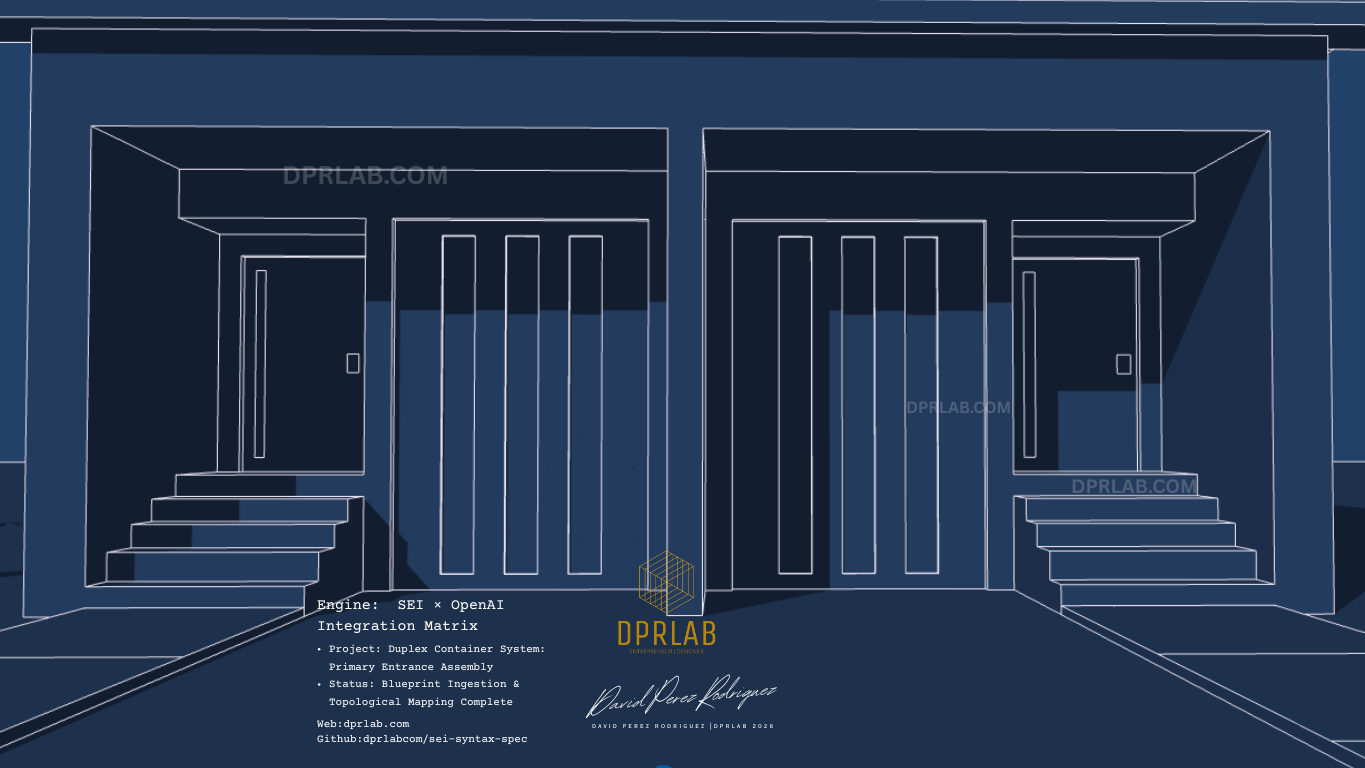
Before any generative processing occurs, the raw CAD geometry is parsed into a definitive “Truth Layer.” This stage mathematically locks the architectural hierarchy, topological boundaries, spatial circulation paths, and fixed structural constraints.
Reference Blueprint File: SEI × OpenAI — Duplex Container System Primary Entrance Assembly.png
02 — MATERIAL SYNTHESIS (Controlled Variables)
With the underlying geometry absolutely locked, the orchestration engine is granted heavily restricted parameters to develop an exterior material system. For this evaluation, the selected parameter was Obsidian Luxury. Because the architectural skeleton cannot be altered, the model’s processing power is forced entirely into surface realism, material behavior, and atmospheric calculations.
03 — HYPER-REALISTIC RENDERING (Compilation)
The indexed architectural intent and the synthesized material language are compiled into a final photorealistic visual environment.
Reference Execution File: SEI × OpenAI — Duplex Container System Primary Entrance Assembly Render.jpg
The Result: Zero Structural Drift
The evaluation yielded a critical operational success: Zero observed structural drift.
The foundational entrance geometry remained completely authoritative. Materiality, lighting, botanical expression, environmental atmosphere, and luxury perception were successfully isolated as controlled creative variables. The AI did not alter the pitch of the roof, the dimensions of the fenestration, or the structural risers of the entry stairs.
This experiment reinforces a central proposition of Synthetic Environment Infrastructure (SEI): When architecture becomes structured information, AI does not have to invent the architecture. It can orchestrate its translation.
“The strategic implementation of blueprints within top-tier LLMs is permanently altering development logistics. The evidence gathered from our recent SEI applications reinforces a critical reality: leveraging established frameworks can significantly boost market readiness. This is not just about operational success; it is about opening new avenues for commercial exploitation and transforming conceptual ideas directly into market-ready solutions.” -dprlab
Commercial Implications & Workflow Compression
The successful execution of this pipeline establishes a new standard for development logistics. The broader objective of this workflow is the total compression of the traditional development timeline:
Concept → Investor → Engineer
By achieving hyper-realistic, zero-drift spatial representation instantly, developers can compress project ambiguity before expensive, formalized professional engineering and architectural documentation begins. This directly mitigates market risk and accelerates capital deployment.
SEI is actively being developed around three unyielding principles:
Blueprint as Code.
Truth as Infrastructure.
AI as Orchestrator.
Open-Source Validation
The abstract SEI Syntax Specification v1.0.0 is publicly available for academic, institutional, and non-commercial validation. The repository thoroughly documents the research primitives that make this workflow possible, including:
Logic Origin Maps
Material Realism Primitives
Spatial Access Anchors
Deterministic Workflow Compression
Explore the complete SEI Syntax Specification on the DPRLAB GitHub repository.