
SEI Workflow: Cinematic Peak Performance in Perception Engineering
Learn how DPRLAB utilizes thermal storytelling and material realism to engineer customer experience

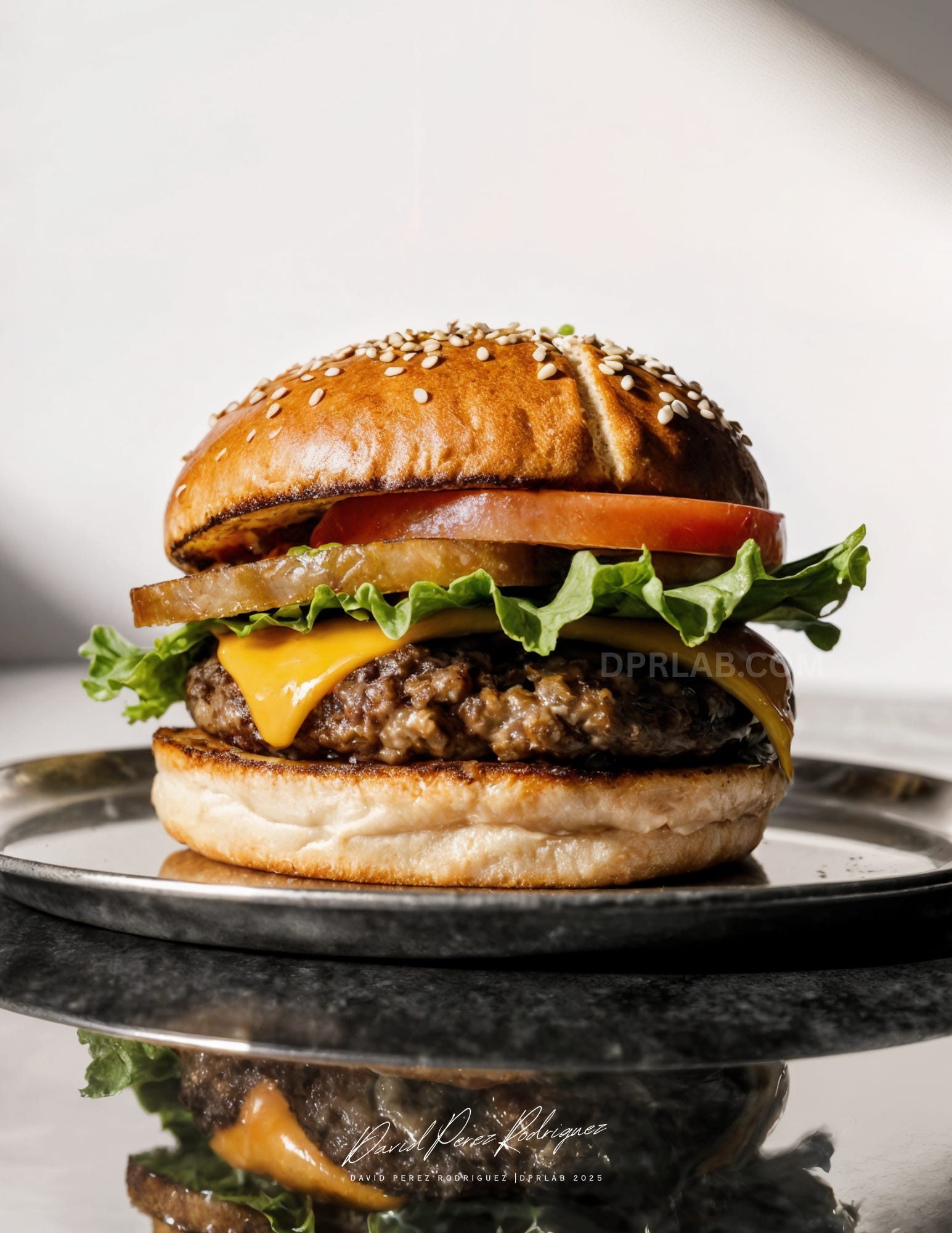
This Is SEI at Cinematic Peak Performance
A Next-Gen SEI Workflow for Enhanced Customer Experience
There’s a fundamental divide between showing food and triggering biological hunger. Most food imagery remains superficial, focusing on composition and color. It communicates what something looks like.
This asset does not. This is a Next-Gen SEI (Synthetic Environment Infrastructure) workflow in motion, where the objective is Perception Engineering: the transition from visual representation to sensory precision. In a world saturated with AI-generated noise, SEI is the signal that bridges the gap between digital pixels and physical desire.
The Shift: From Image to Sensory Experience
Traditional photography asks: What does it look like? SEI reframes the core inquiry: What does it feel like to exist in this space?
This asset utilizes Material Realism to compress the distance between the viewer and the object. You are not observing; you are standing over it. You can almost hear the fat rendering and feel the residual heat. This outcome is a disciplined output of the SEI Layer 2 framework, Multi-Mode Visualization. By simulating the physics of light and matter, we bypass the viewer’s skepticism and speak directly to their limbic system.
1. Mastery of Thermal Storytelling
Temperature is an invisible driver of appetite. In the SEI workflow, we treat heat as a data point that must be visualized to be felt. SEI translates thermal data into visual signals:
Active Melt Behavior: The cheese is not a static prop; its flow behavior signals precise heat levels and viscosity.
Thermal Glisten: Surface moisture indicates active fat rendering a “sweat” that signals juice rather than static dryness.
Toasted Indices: The micro-cracks and gloss on the brioche bun suggest a recent Maillard reaction, grounding the asset in a specific temporal moment.
2. Precision in Material Realism
At this level, realism is about credibility under cognitive scrutiny. Our brains are evolved to detect “wrongness” in organic matter. When materials like the translucency of a tomato or the cellular tension of lettuce behave with physical accuracy, the brain stops questioning and starts accepting.
This is Material Control within a controlled sensory system. By defining the refractive index of the onion and the irregular surface scattering of the meat, we create an environment that feels “heavy” and “present.” This isn’t just a render; it is a digital twin of a sensory experience.
3. The Reflection: Engineering Perception
The reflective surface is not aesthetic filler; it is a Spatial Behavior Simulation tool. In the SEI workflow, reflections serve as a “gravity well” for the eye. It reinforces symmetry and focus, slowing the eye’s saccadic movement the rapid, jerky movement of the eye between fixated points. In that forced pause, consumer desire compounds. The reflection proves the object’s existence in a physical world, doubling the sensory data points without cluttering the frame.
4. Market Position: The Infrastructure of Influence
Most industries are currently trapped in “Legacy Output Thinking” producing images as final products. SEI views images as Infrastructure. By building these assets within an SEI framework, a brand isn’t just making an ad; they are building a repeatable, scalable system of Cognitive Influence. As we move deeper into the 2026 LLM-driven market, the advantage belongs to those who control the “Sensory Semantic” layer. The early adopters of SEI are not just keeping pace with technology; they are defining the new standard of “Digital Realism” before the market reaches its peak.
Final Position
This is what cinematic peak performance looks like within a next-gen SEI workflow. Not louder. Not more complex. More intentional. Because when every variable is controlled, the outcome is consistent: The viewer doesn’t analyze. They respond.
“The infrastructure of the image is the infrastructure of the mind.” -DPRLAB