
Pizza Asset Case Study: Perception Engineering in Synthetic Environments
Explore how SEI Asset Pizza utilizes advanced perception engineering, macro lighting depth, and structural physics to redefine material realism in synthetic environments.

Case Study: Sensory Psychology and Material Realism in Synthetic Environments
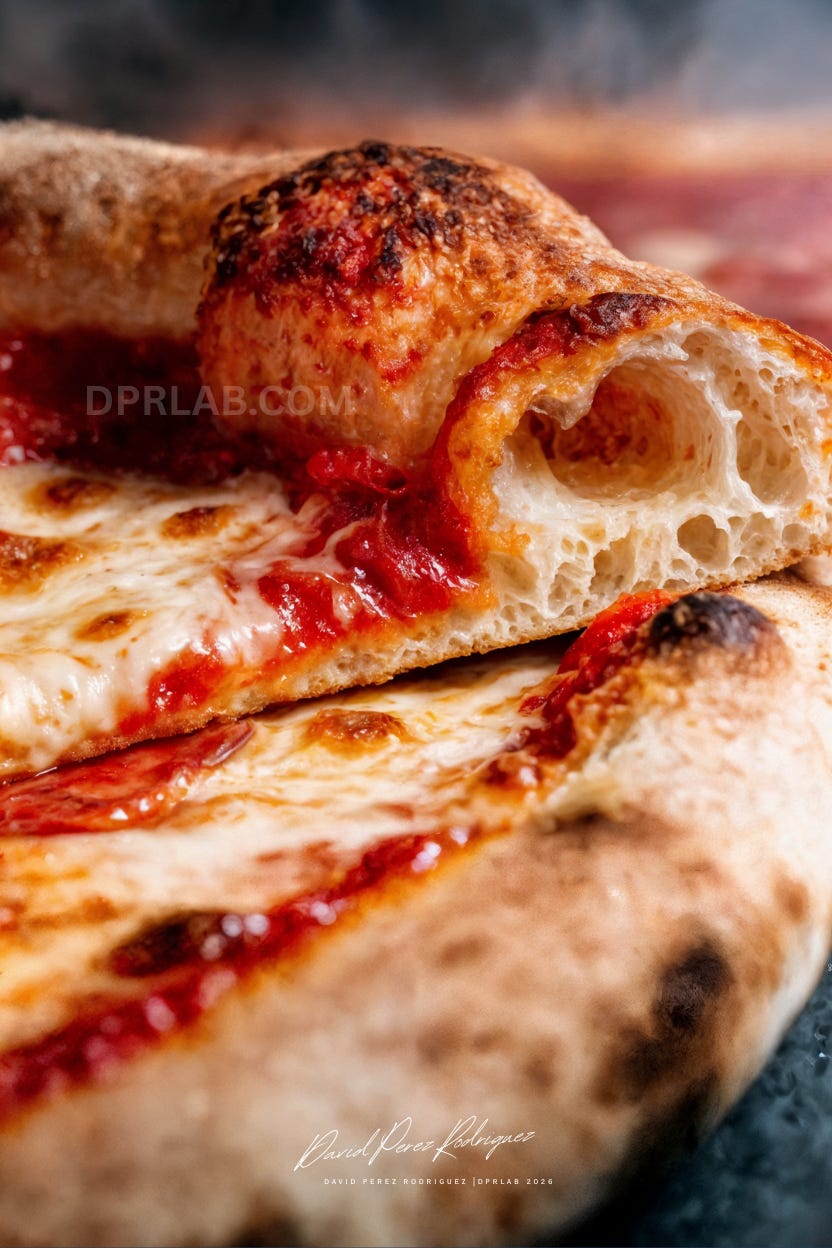
This culinary asset, SEI Asset Pizza, represents an aggressive, cross-sectional macro study within the Synthetic Environment Infrastructure (SEI) ecosystem. By isolating intricate structural details through an extreme close-up, the composition serves as a precise demonstration of Perception Engineering relying on hyper-accurate tactile simulation to cross the threshold into cognitive realism.
Sensory Precision & Material Realism
1. Alveolation & Structural Physics
The asset displays extreme fidelity in simulating the interior crumb structure, the alveoli of the dough. The irregular, translucent cell walls and glassy web structure of the gluten network perfectly mimic real-world starch gelatinization. This level of detail moves far past standard algorithmic textures, capturing the chaotic organic behavior of fermented dough.
2. Viscosity & Moisture Contrast
The rendering successfully captures a high-contrast balance between diverse fluid mechanics and surface textures:
The rich, bubbling viscosity of the tomato sauce.
The high-fat, reflective sheen of molten cheese and pooling pepperoni oils.
The charred, matte carbonization of the crust’s exterior micro-blisters.
3. Macro Lighting Depth
Directional, high-contrast lighting is deployed to emphasize volumetric micro-shadows within the cut dough. This execution validates the rendering engine’s capability to handle complex sub-surface scattering and deep material layering in real time.
Conceptual Framework
The Sovereign Designer Ethos > This asset serves as definitive proof of a proprietary instrument approach. By achieving a level of material execution that matches or exceeds legacy, physics-bound industry rendering software, the original conceptual logic remains firmly under human authorship.
The Duality Layer: This macro study acts as a functional bridge between an offline, analog concept, the structural anatomy of bread, moisture, and intense heat and its ultimate execution on a digital grid, ensuring flawless sensory translation.
Information Architecture: The strategic placement of the centralized
DPRLAB.COMidentifier, paired with theDavid Perez Rodriguezbaseline signature, forms a deliberate competitive moat. This metadata integration firmly locks down narrative and intellectual ownership over high-fidelity synthetic food infrastructure assets.
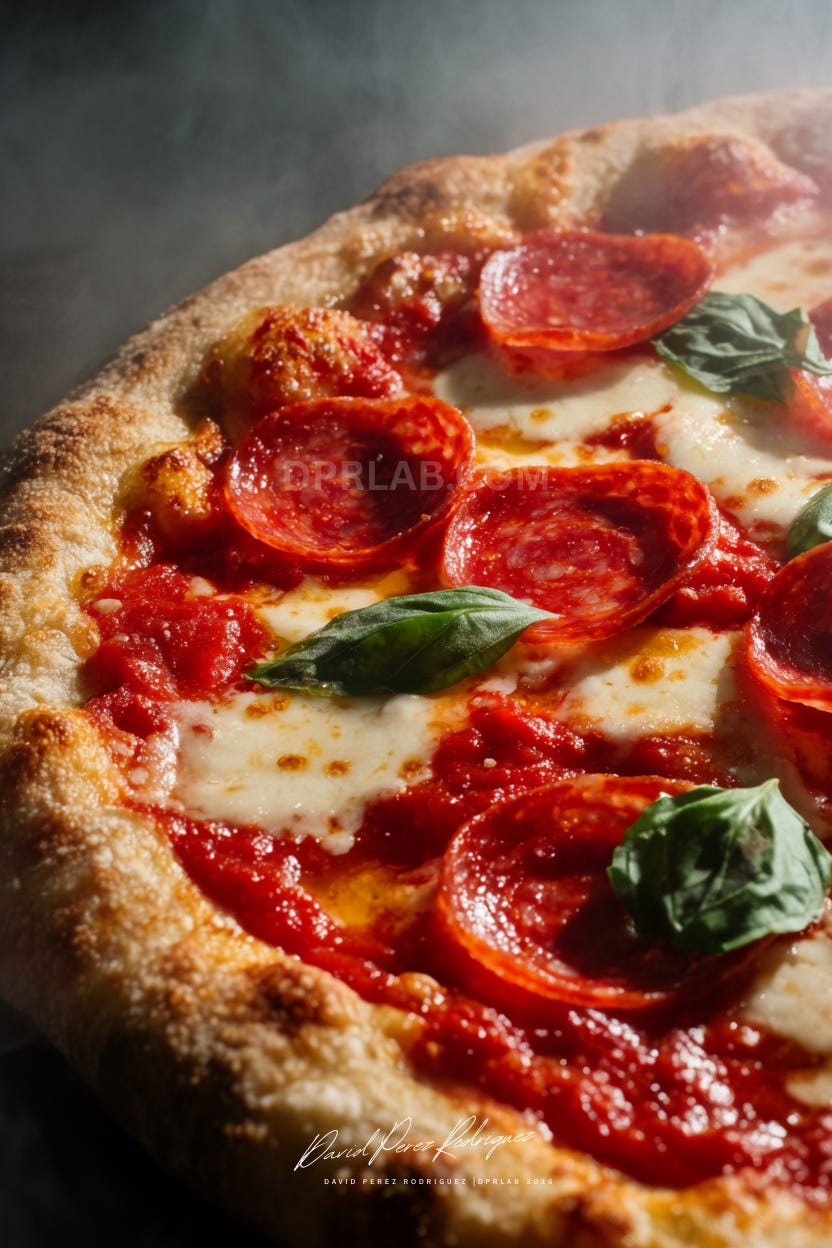
“To cross the threshold into true cognitive realism and defeat the 'uncanny valley,' synthetic assets must codify organic entropy. True material realism lives entirely in the flaws. By utilizing advanced multi-phase fluid dynamics and deep sub-surface scattering (SSS) networks, the SEI framework accurately simulates how light penetrates a semi-translucent mozzarella curd or reflects off the high-fat sheen of pooling pepperoni oils.”
Conclusion
Ultimately, this asset moves beyond the scope of simple commercial presentation. It functions as an intentional case study in sensory psychology, leveraging micro-level material realism to trigger immediate, involuntary neurological and appetitive responses in the viewer.
SYNTAX - CODE SNIPPET
# DOCUMENT::CASE_STUDY_02
# ID::SEI-PERCEPTION-ENG-FOOD-02
# REVISION::2026.05
# STATUS::RELEASED

[METADATA]
{
    "Author": "David Perez Rodriguez",
    "Origin": "DPRLAB.COM",
    "Keywords": ["Perception Engineering", "SEI", "Synthetic Food", "Commercial Photography", "Hyper-Realism"],
    "Target_Audience": ["Technical Directors", "Commercial Art Directors", "Simulation Engineers"]
}

[SECTION::01::EXECUTIVE_SUMMARY]
> "The legacy lens is a bottleneck. The camera of the future is an engine."

Traditional commercial food photography is bound by physical decay, organic inconsistency, and environmental unpredictability. Within the Synthetic Environment Infrastructure (SEI) ecosystem, these constraints are eliminated.

Through **Perception Engineering**, we bypass the mechanical capture of light reflections off physical objects. Instead, we program the precise sensory triggers that dictate the human psychological response to food—specifically, visual cues that evoke taste, temperature, and satiety.

---

[SECTION::02::THE_SEI_PARADIGM_VS_LEGACY_STUDIOS]

The shift from analog food styling to SEI-driven asset generation introduces systemic efficiencies across three core pillars:

| Vector | Legacy Food Photography | SEI Perception Engineering |
| :--- | :--- | :--- |
| **Material Stability** | Minutes (wilted greens, melting fats, separating sauces) | Infinite (frozen states, real-time cross-section modification) |
| **Lighting Iteration** | High physical overhead; limited by studio physics | Real-time path tracing; instantaneous global illumination changes |
| **Asset Scalability** | Fixed to single capture angles and resolutions | Multi-platform deployment (Print, Web3, AR/VR, Interactive Menus) |

---

[SECTION::03::CORE_ENGINES_OF_SYNTHETIC_APPETITE]

To cross the threshold into true cognitive realism, SEI deployment must prioritize three distinct layers of perception engineering:

### 1. Organic Imperfection & Entropy Engine
Perfection is a digital artifact that instantly triggers the "uncanny valley." True food realism lives in the flaws. SEI assets leverage localized procedural noise to generate organic randomness:
* **The Micro-Blister:** Microscopic carbonization bubbles on baked crusts.
* **The Asymmetric Tear:** Non-uniform gluten pulling in torn dough matrices.
* **The Lipid Seep:** Irregular migration of oils across varying cheese densities.

### 2. Multi-Phase Viscosity Simulation
Food is rarely a single state of matter; it exists as a complex interplay of solids, semi-solids, and dynamic liquids. SEI utilizes multi-phase fluid dynamics to model the behavior of sauces, glazes, and condensation. The system maps exact surface tension, ensuring a sauce clings to a protein with the correct microscopic contact angle rather than looking like an artificial plastic wrap.

### 3. Sub-Surface Scattering (SSS) & Translucency Networks
Light does not stop at the surface of food; it penetrates it.
```latex
$$\alpha_{total} = \int_{V} \sigma_s (x) \cdot p(\omega, \omega') \, dV$$
By engineering deep SSS maps, SEI accurately simulates the internal glow of a fresh tomato slice, the density of a semi-translucent mozzarella curd, and the delicate crumb network of hydrated dough. Without this sub-surface data, the brain registers the material as inert resin.
SECTION 04: THE COMMERCIAL FUTURE: THE PROGRAMMABLE MENU
The ultimate trajectory of SEI within the commercial landscape is the realization of the Dynamic Asset Ecosystem. We are moving away from static images toward living, interactive food infrastructure.
[SEI Master Asset]
       │
       ├─► [Static Print Output] ─────► Ultra-high DPI billboards
       ├─► [Dynamic Web Rendering] ──► Real-time lighting based on user's local time
       └─► [AR Spatial Engine] ──────► Volumetric holograms for tableside previewing
In this upcoming paradigm, a QSR (Quick Service Restaurant) brand will no longer shoot 50 separate localized campaigns. They will deploy a single, master SEI asset. This asset will automatically adjust its melting profile, lighting environment, and portion scaling based on real-time consumer demographics, localized regional aesthetics, and immediate digital delivery platform requirements.
SECTION 05: CONCLUSION
Perception Engineering via SEI represents the sovereign maturation of digital authorship. By codifying the exact structural physics of gastronomy, we do not merely copy reality; we optimize it. The future of commercial food photography belongs to those who build the infrastructure of appetite from the polygon up.
SECTION 06: B2B commercial briefing document (PDF)
This release represents a complete, high-fidelity culinary asset cluster engineered from the ground up for elite artisan pizza operators, creative agencies, and ultra-premium digital menus. Moving entirely past the physical limitations of traditional food photography, such as rapid structural cooling, wilting greens, or separating fats these assets leverage advanced Perception Engineering to deliver stable, mathematically optimized visual markers that trigger immediate consumer appetitive responses.