


Synthetic Environment Infrastructure (SEI): The Blueprint-as-Code Epoch in Modular Architecture
The era of “generative-at-all-costs” in spatial design has reached its natural conclusion. For years, the application of artificial intelligence in architecture and physical engineering was dominated by visual diffusion models tools that generated stunning, hyper-realistic images that ultimately collapsed when confronted with structural physics, building codes, or manufacturing realities.
At DPRLAB R&D, we are pioneering a fundamental paradigm shift: Synthetic Environment Infrastructure (SEI) driven by Blueprint-as-Code (BaC).
By treating architectural geometry as structured syntax rather than descriptive prose, SEI transforms Large Language Models (LLMs) from superficial “paints” into deterministic compilation and orchestration engines. This philosophical and operational transformation closes the perception gap between design and engineering, unlocks real-time capital deployment, and establishes an accelerated pipeline for modular and rapid-deployment construction systems.
"The transition from 'generative-at-all-costs' to deterministic orchestration engines marks the official maturation of artificial intelligence in spatial design and industrial prefabrication." -dprlab.com
The Paradigm Shift: From Visual Diffusion to Spatial Compilation
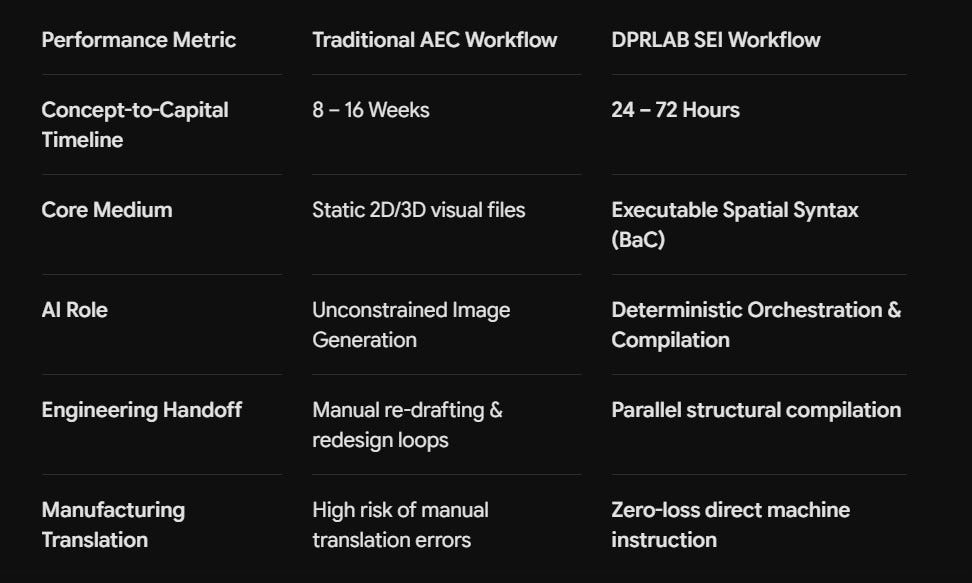
In traditional Architecture, Engineering, and Construction (AEC) workflows, a severe friction point exists between the conceptual designer and the structural engineer. A designer creates a static visual concept; an engineer must then manually recreate or translate that visual into structural, mechanical, and physics-based software (such as SAP2000 or ANSYS). If the design fails compliance or stress tests, it is sent back for a costly redesign.
[ TRADITIONAL LINEAR PIPELINE ]
Concept (Weeks) ──> Static Drawings ──> Manual Re-Drafting ──> Engineering Failures ──> Redesign Loop
                                                                                           │
                                                                                           ▼
                                                                        Capital Delay & Friction

[ DPRLAB SEI OPERATIONAL PIPELINE ]
Concept Syntax ──> LLM Compilation Engine (SEI) ──> Real-Time Physics & Code Verification ──> Instant Execution
Synthetic Environment Infrastructure replaces this disjointed handoff with a Blueprint-as-Code framework.
Spatial Intent as Executable Syntax: Buildings and structural modules are declared through precise, machine-readable schemas (BIM parameters, CAD primitives, structural load limits, and material constraints).
LLMs as Low-Cost Compilers: Instead of running heavy, expensive multimodal models to render raw pixels, lightweight LLMs serve as symbolic translators. They parse spatial syntax, run optimization loops (e.g., thermal performance, structural integrity, egress routes), and output validated, machine-executable specs.
Lossless Execution: The gap between concept and fabrication vanishes. The output is not an approximation, it is a deterministic blueprint that compiles directly into manufacturing instructions.
Accelerating Capital Velocity in Modular & Rapid Deployment
In high-stakes, modular sectors such as luxury residential container systems, disaster relief housing, or rapid-deployment industrial units, the carrying cost of pre-construction capital is a massive growth bottleneck. Securing equity or private funding traditionally requires months of manual estimation, site surveys, and engineering reviews.
┌─────────────────────────────────────────────────────────────────────────────────┐
│                       SEI OPERATIONAL WORKFLOW PIPELINE                         │
├──────────────┬───────────────────┬──────────────────────┬───────────────────────┤
│   CONCEPT    │     INVESTOR      │       ENGINEER       │     MANUFACTURING     │
│ Spatial      │ Underwriting &    │ Structural           │ Direct CNC /          │
│ Syntax       │ Financial         │ Optimization         │ Robotic Prefab        │
│ Prompts      │ Velocity          │ & Compliance         │ Assembly              │
└──────┬───────┴─────────┬─────────┴──────────┬───────────┴───────────┬───────────┘
       │                 │                    │                       │
       └─────────────────┴─────────┬──────────┴───────────────────────┘
                                   │
                      LLM COMPILATION ENGINE (SEI)
               Translates Spatial Intent <--> Machine Code
Under the DPRLAB SEI Operational Workflow, the Concept > Investor > Engineer > Manufacturing continuum is drastically compressed:
Instant Financial Underwriting: The moment a conceptual designer declares a spatial schema (e.g., a 3-unit stacked container home with off-grid solar integration), the SEI engine compiles it into an exact Bill of Materials (BOM), cost-quantized yield analysis, and embodied carbon score. Investors underwrite verified assets in hours, not months.
Parallel Engineering Optimization: Once funding is locked, engineers do not start from scratch. Structural load parameters and local environmental boundary conditions (wind shear, seismic ratings) are fed directly into the SEI engine. The system automatically optimizes internal structural members, allowing engineers to step into the role of System Architects.
Direct-to-Fabrication Pipelines: The compiled syntax emits machine-executable code (IFC, G-code, robotic assembly paths) straight to the factory floor. Laser steel cutters and CNC mills execute instructions directly from the validated design file.
"By coupling low-cost LLM orchestration with machine-readable blueprints, we eliminate pre-construction carrying friction and dramatically accelerate the velocity of capital." -dprlab.com
Restoring Artistry to Engineering
For decades, structural and MEP engineers have been treated as downstream “fixers” tasked with fitting rigid physical constraints into unrealistic visual drafts.
By expressing the blueprint as code, SEI elevates the engineer’s role. Engineering ceases to be a reactive chore of redlining drafts and becomes an active, generative artform. Engineers manipulate systemic variables, define environmental boundary conditions, and watch the compilation engine optimize elegant, structurally sound physical forms in real time.
Operational Impact & Benchmark Overview
The Path Ahead
The convergence of Synthetic Environment Infrastructure (SEI) and Blueprint-as-Code (BaC) shifts artificial intelligence from a novel creative playground into a core industrial orchestration layer. By grounding architectural intent in deterministic code, DPRLAB R&D is building the framework to turn spatial concepts into physical, code-compliant realities at unprecedented speed.